High Cholesterol and Triglycerides: Lipid Profile Explained
In brief
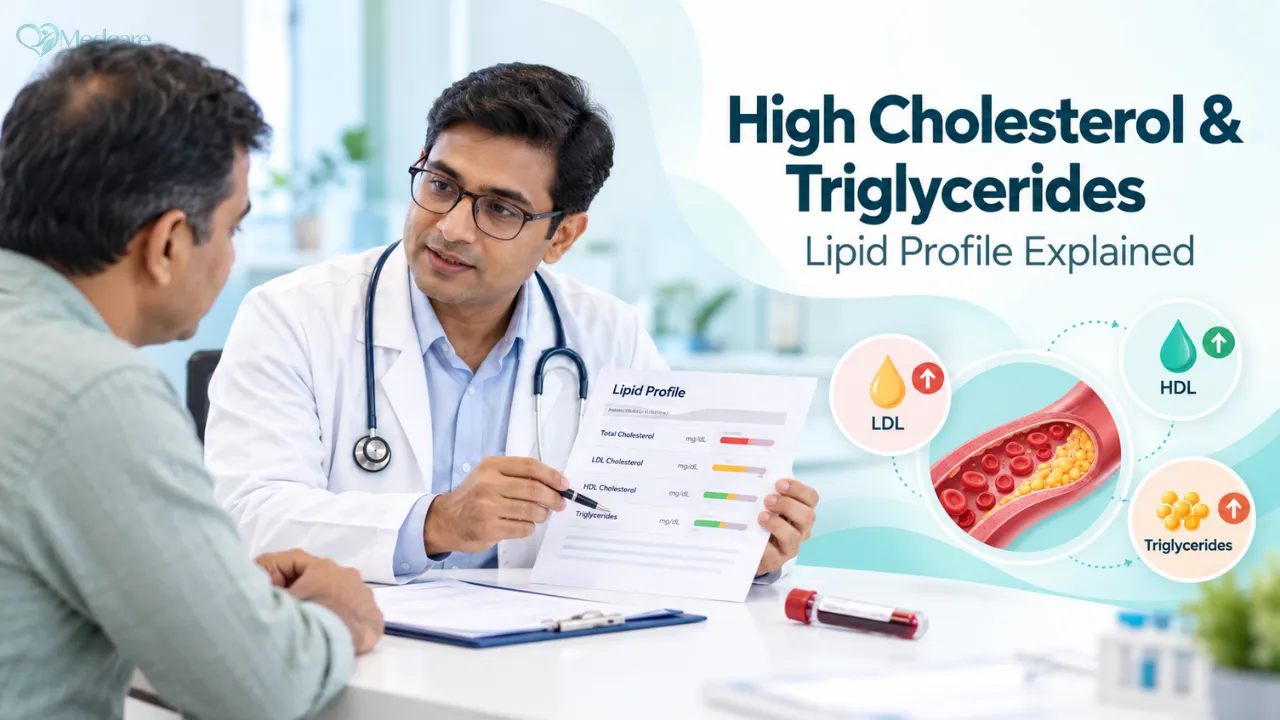
- High cholesterol means there is more LDL ("bad") cholesterol in your blood than is healthy for your heart. You usually cannot feel it. A blood test called a lipid profile finds it.
- The lipid profile reports total cholesterol, LDL, HDL ("good") cholesterol and triglycerides. Doctors watch LDL most closely.
- Your LDL target depends on your overall heart risk. People with diabetes, kidney disease or a past heart attack or stroke need a lower number.
- High triglycerides often come with diabetes, belly fat, fatty liver, alcohol and meals heavy in rice and sugar.
- Many people need a statin along with food and activity changes. Statins lower the chance of heart attack and stroke, and most people take them without problems.
- Every adult should have a lipid profile at least once. If you have diabetes, high BP or obesity, check it every year.
High cholesterol is when the LDL cholesterol in your blood, and sometimes the triglycerides, stays higher than your heart can safely handle. Over many years this extra fat settles inside the walls of your arteries and narrows them. Most people feel nothing at all, so the first sign is often a number on a routine report.
This guide walks through that report line by line, what pushes the numbers up, how treatment works, and when to see a doctor.
What is cholesterol, and why does the body need it?
Cholesterol is a soft, waxy fat. The liver makes most of it. Food supplies the rest.
You cannot live without it. Every cell wall contains cholesterol, and the body uses it to make some hormones and vitamin D. Trouble starts only when too much of one type stays in the blood for years.
Because fat and blood don't mix, cholesterol travels inside tiny carriers called lipoproteins. Two of them show up on your report, LDL and HDL.
What is LDL ("bad") cholesterol?
LDL (low-density lipoprotein) takes cholesterol from the liver out to the body.
Extra LDL can lodge in the inner lining of an artery and build up into a fatty lump called plaque. Doctors call this atherosclerosis. A plaque narrows the artery. If it cracks, a blood clot forms on it, and the clot can shut the artery completely. That causes a heart attack when it happens in the heart and a stroke when it happens in the brain.
What is HDL ("good") cholesterol?
HDL (high-density lipoprotein) picks up extra cholesterol and takes it back to the liver for disposal.
People with low HDL tend to have more heart disease. Even so, medicines that raise HDL have not prevented heart attacks in trials. That is why your doctor will talk far more about bringing LDL down than about getting HDL up.
What are triglycerides?
Triglycerides are the fat your body stores from spare calories. Sugar, white rice, maida, sweets and alcohol all raise them quickly.
High triglycerides add to heart risk, more so when HDL is low at the same time. When they climb very high, they can inflame the pancreas (pancreatitis), which is painful and can be dangerous.
What does a lipid profile test measure?
The test needs a small blood sample from a vein in your arm. A typical Indian lab report shows these values.
| Test | What it tells you |
|---|---|
| Total cholesterol | All the cholesterol in your blood |
| LDL cholesterol | The type that builds plaque |
| HDL cholesterol | The type that clears extra cholesterol |
| Triglycerides | Stored fat from spare calories, sugar and alcohol |
| VLDL cholesterol | A triglyceride-rich carrier, usually calculated rather than measured |
| Non-HDL cholesterol | Total cholesterol minus HDL |
| Ratios (Total/HDL, LDL/HDL) | Extra figures some labs print |
Most labs calculate LDL from the other numbers instead of measuring it. The calculation goes wrong when triglycerides are very high. In that case your doctor may order a direct LDL test or rely on the non-HDL figure.
Do I need to fast before a lipid profile?
Usually not. A non-fasting sample works well for most people. If your triglycerides were high last time, or the result looks odd, you may be asked to come after 10 to 12 hours without food. Drinking plain water is allowed.
Skip alcohol and fried, heavy food the night before your test. Either one can raise triglycerides for a day or two and give a misleading result.
Are there any other cholesterol tests?
Two more come up sometimes. Lipoprotein(a), or Lp(a), is a cholesterol particle you inherit, and a high level raises heart risk. Several international guidelines suggest testing it once in adult life, especially when early heart attacks run in the family. Apolipoprotein B (ApoB) counts harmful particles more directly. Most people do not need either test.
What are normal cholesterol and triglyceride levels?
These adult ranges are in mg/dL and are widely used. The range on your own lab report may be slightly different.
| Test | Desirable | Borderline | High |
|---|---|---|---|
| Total cholesterol | Below 200 | 200 to 239 | 240 or more |
| LDL cholesterol | Below 100 | 100 to 159 | 160 or more (190 or more is very high) |
| HDL cholesterol | 40 or more in men, 50 or more in women | Not applicable | Below these values is low |
| Triglycerides | Below 150 | 150 to 199 | 200 to 499 (500 or more is very high) |
Why does my doctor worry when the lab says "normal"?
The lab prints one range for every adult. Your heart risk is personal. An LDL of 120 mg/dL may be fine for a healthy 30-year-old. For a 55-year-old with diabetes and high BP, the same 120 is often too high.
What is a good LDL level for me?
Your doctor first estimates how likely you are to have a heart attack or stroke over the coming years. The LDL target follows from that.
| Your situation | LDL target often used |
|---|---|
| Low risk, no major risk factors | Below 100 mg/dL is usually acceptable |
| Diabetes, or several risk factors such as high BP, smoking or family history | Often below 70 mg/dL |
| Past heart attack, stroke, angioplasty or bypass surgery | Often below 55 mg/dL |
| LDL of 190 mg/dL or more at any age | Usually treated with medicine, plus a check for inherited high cholesterol |
Groups such as the American Diabetes Association, the European Society of Cardiology and the Lipid Association of India use targets close to these. They differ in small ways, and your doctor will pick the one that fits you.
You may also see a non-HDL target on your plan. It is normally about 30 mg/dL higher than the LDL target. An LDL goal below 70 goes with a non-HDL goal below 100.
What causes high cholesterol and high triglycerides?
In most people it is a combination. Diet and habits play a part, other illnesses play a part, and genes play a part.
Food and daily habits
- Ghee, vanaspati, butter, fatty pork, red meat and full-cream milk products
- Deep-fried snacks, packaged namkeen, some bakery items and oil that has been reused for frying
- Big helpings of white rice and maida, and sweets or sugary tea through the day, which mostly push up triglycerides
- Alcohol, which can raise triglycerides a lot
- Sitting for most of the day with little walking or physical work
- Smoking, which lowers HDL and injures the lining of blood vessels
Weight and other health problems
- Extra weight, particularly around the belly
- Type 2 diabetes or prediabetes
- An underactive thyroid (hypothyroidism)
- Fatty liver
- Kidney disease, especially with protein leaking into the urine
- PCOS
- Certain medicines, including some steroids, some water tablets (diuretics) and some HIV treatments. Keep taking them, and ask your doctor.
Family history and genes
In some families, LDL is very high from childhood onwards. This is familial hypercholesterolaemia. Your doctor may suspect it if your LDL is 190 mg/dL or more, if a parent or sibling had a heart attack young, or if you have fatty lumps over tendons or yellow patches on the eyelids.
People of South Asian origin often show a typical mix of high triglycerides, low HDL and small, dense LDL particles. It usually comes with belly fat and diabetes. Heart risk with this pattern can be high even when total cholesterol is only a little raised.
Does high cholesterol cause any symptoms?
Almost never. Many people learn about it only after a heart attack or stroke, and that is the reason routine testing is worth doing.
When levels are very high, or the problem is inherited, a few visible signs can appear:
- flat yellowish patches on or around the eyelids (xanthelasma)
- firm lumps over tendons at the back of the heel, the knuckles or the knees (xanthomas)
- a grey or white ring around the iris in a young person (corneal arcus)
Very high triglycerides may cause bouts of severe pain in the upper abdomen from pancreatitis. Go to hospital if this happens.
How does high cholesterol increase heart attack and stroke risk?
Plaque builds up slowly, a little at a time, for years. As it grows, the artery narrows. In the heart, a narrowed artery may cause chest tightness or breathlessness while walking uphill or climbing stairs, and the pain settles with rest.
A heart attack usually happens differently. A plaque that may not have been very large cracks open, a clot forms within minutes, and blood flow stops.
The same disease in the arteries of the neck and brain leads to stroke. In the legs it causes calf pain on walking and slow healing of foot wounds, which worries doctors most in people with diabetes.
Plaque grows in proportion to how high LDL is and how long it stays high. Lowering LDL early and keeping it down for years does more good than one good report.
What else adds to the risk?
High cholesterol rarely acts alone. Risk climbs steeply when it sits alongside any of these:
- high blood pressure
- diabetes
- smoking or chewing tobacco
- belly fat
- long-term kidney disease
- heart disease in a father or brother before 55, or a mother or sister before 65
- older age, and being male
- sleep apnea
Someone with three or four of these can be at far higher risk than a person with high cholesterol and nothing else.
How are diabetes and cholesterol linked?
Diabetes upsets the way the body handles fat. High sugar and insulin resistance (the body responding poorly to its own insulin) make the liver release more triglycerides. HDL drops. LDL particles shrink and become more likely to get into artery walls.
A person with diabetes can have a report that looks only mildly abnormal and still carry a lot of risk. Most guidelines therefore suggest that adults with diabetes, roughly between 40 and 75 years of age, be considered for a statin even if LDL is not very high. Your doctor makes that call.
Better sugar control often lowers triglycerides. It does little for LDL, which is where a statin comes in. You usually need both. Read more aboutdiabetes care at Medcare.
Can thyroid problems or fatty liver raise cholesterol?
Yes, both can. A slow thyroid clears LDL from the blood more slowly, so LDL rises, and it often falls again once the thyroid is treated. Doctors commonly order a thyroid test when they see a new high LDL. More onthyroid disorders.
Fatty liver and high triglycerides tend to show up in the same person, along with belly fat and insulin resistance. When one improves, the other usually does too. More onfatty liver.
How is high cholesterol treated?
Treatment rests on daily habits for everyone, with medicine added for many. The real goal is fewer heart attacks and strokes over the years ahead.
Lifestyle changes
Better food and more movement help every patient. In someone young with mildly high cholesterol and low risk, they may be all that is needed. They tend to lower triglycerides well. Their effect on LDL is smaller, and much smaller when high LDL is inherited.
When are medicines started?
Your doctor looks at your LDL, your age and your other risk factors together. Medicine is commonly advised if:
- you have had a heart attack, stroke, angioplasty or bypass
- you have diabetes, especially if you are over about 40 or have other risk factors
- your LDL is 190 mg/dL or higher
- your overall risk is high, even with a moderately raised LDL
- a few months of lifestyle changes have not brought you to target
What are statins and how do they work?
Statins are the medicines most often used to lower cholesterol. In India, atorvastatin and rosuvastatin are the ones most people are prescribed.
A statin slows down cholesterol making in the liver. The liver responds by pulling more LDL out of the blood. Statins also make existing plaque more stable and less likely to crack.
They have been studied in very large numbers of people for decades. In people at raised risk, they reduce heart attacks, strokes and deaths from heart disease, and the benefit builds the longer they are taken.
Your doctor chooses the statin and dose according to how far your LDL needs to come down. Please do not change the dose or stop on your own.
What are the side effects of statins?
Most people have none. When side effects occur, these are the usual ones.
- Muscle aches or weakness. Some people notice this, although careful studies show that many such aches are not actually caused by the statin. Serious muscle damage is rare.
- Raised liver enzymes on a blood test, usually mild and harmless.
- A small rise in blood sugar. A person already close to diabetes may cross the line. In people at raised heart risk, the protection from heart attack and stroke is generally far greater.
- Occasional stomach upset or headache.
Tell your doctor about new muscle pain, dark-coloured urine or unusual weakness. A lower dose or a switch to another statin often sorts it out.
Do statins need to be taken for life?
For most people who need one, yes. A statin protects you only while you keep taking it. Stop it, and LDL generally climbs back to where it was within a few weeks.
There are exceptions. A person with mild, lifestyle-related high cholesterol who loses a good amount of weight and keeps up the changes may be able to cut down or stop. Only do this with your doctor, and recheck your levels afterwards.
What other cholesterol medicines are there?
If a statin is not enough, or you cannot tolerate one, your doctor may consider:
- ezetimibe, which reduces how much cholesterol the gut absorbs and is often combined with a statin
- PCSK9 inhibitors and similar newer injections, which lower LDL strongly and are kept mainly for very high risk or inherited high cholesterol
- bempedoic acid, a tablet for some people who cannot take statins
- fibrates, used mostly for very high triglycerides
- prescription omega-3 medicines for high triglycerides in selected patients
Fish oil capsules from the chemist and herbal cholesterol products cannot replace these.
What can I do at home to lower cholesterol and triglycerides?
Pick a few changes you can live with and keep them going. A strict diet that lasts two weeks does very little.
Food
Fill half your plate with vegetables. Saag, lai, lau, pumpkin, beans and cabbage are all good, and so is whatever is fresh at the local bazaar.
Keep eating rice if you enjoy it, but serve less of it at each meal and take more dal, vegetables or fish instead.
River fish in a light curry or tenga is an excellent choice. Fried fish is less so. Pork fat, mutton and organ meats are best kept for occasional meals in small portions.
Mustard oil is a reasonable cooking oil, but the amount in the kadhai still matters. Use less, and throw out oil once it has been used for deep frying. Go easy on ghee, butter, vanaspati and full-cream milk products.
Cut the sugar in your tea a little at a time until you get used to it. Sweets, pitha and laddoos belong to festivals, and even then a small piece is enough.
Fibre helps bring LDL down. Whole dal, rajma, chana, vegetables, fruit eaten with the skin and whole grains such as atta roti or brown rice are easy ways to get more of it. For a snack, a handful of roasted chana or unsalted peanuts beats biscuits and packaged namkeen.
At Bihu and Durga Puja, enjoy the feast in smaller portions, then go for a 20 to 30 minute walk afterwards.
Activity
Try to reach about 150 minutes of brisk walking a week. Thirty minutes on 5 days works for most people. Field work, gardening, cycling and taking the stairs all count. If you sit for long hours, get up and move for a few minutes every hour.
Check with your doctor first if you get heart symptoms, have diabetes complications or have not exercised for a long time.
Weight, alcohol and tobacco
Losing even a modest amount of weight, especially from the belly, often lowers triglycerides and lifts HDL. Cutting down on alcohol, or giving it up, can bring triglycerides down sharply. Giving up smoking and chewing tobacco lowers heart risk whatever your cholesterol report says.
If you have struggled to lose weight on your own, medically supervisedweight management may help.
Common myths about cholesterol
"I'm thin, so my cholesterol is fine." Thin people can have very high LDL, especially when it runs in the family.
"I feel well. Why test?" High cholesterol almost never causes symptoms, and only a blood test shows it.
"Statins damage the liver and kidneys." Serious liver problems from statins are rare, and statins do not harm healthy kidneys. Your doctor may check blood tests before and during treatment.
"My report is normal now, so I can stop the tablet." A normal report while on a statin usually means the medicine is doing its job. Stopping it tends to bring LDL back up.
"Mustard oil is healthy, so the amount doesn't matter." Every oil is high in calories. Quantity counts as much as type.
"Garlic or lemon water can replace my medicine." They can be part of a healthy diet, but there is no good evidence that they lower LDL enough to replace prescribed treatment.
How often should I check my lipid profile?
| Situation | How often (general guide) |
|---|---|
| Healthy adult with no risk factors | At least once in early adulthood, then every few years |
| Diabetes, high BP, obesity, smoking or family history | Usually once a year |
| After starting or changing a cholesterol medicine | Often after 6 to 12 weeks, then as advised |
| Very high LDL or early heart disease in the family | Start earlier, and consider testing close relatives |
Your doctor may suggest a different schedule. A yearlypreventive health check-up makes it easy to remember.
When should you see a doctor?
Make an appointment if:
- any of your lipid values is above the desirable range
- your LDL is 190 mg/dL or more, or your triglycerides are 500 mg/dL or more
- you have diabetes, high BP, kidney disease or obesity and have not had a lipid profile in the last year
- a parent, brother or sister had a heart attack or stroke at a young age
- you have noticed yellow patches on your eyelids or lumps over your tendons
- a cholesterol medicine is giving you side effects
Red-flag symptoms that need emergency care
Call 108 or 112 straight away for:
- chest pain, pressure or heaviness lasting more than a few minutes, especially if it spreads to the arm, jaw or back
- sudden breathlessness, sweating, vomiting or fainting
- sudden weakness or numbness of the face, arm or leg, slurred speech or confusion
- severe pain in the upper abdomen going through to the back, especially if you know your triglycerides are very high
In people with diabetes, a heart attack can show up as nothing more than breathlessness or sudden tiredness. If something feels wrong, do not wait.
At Medcare
Dr. Das reviews your lipid profile alongside your sugar, BP, weight, thyroid and kidney reports, since your LDL target depends on all of them. When the heart needs a closer look, ECG andechocardiography are done in the clinic, and body composition analysis can track belly fat as you lose weight. You can get the lipid profile done at any lab you prefer and bring the report along. Patients travelling from Kokrajhar, Chirang, Dhubri, Goalpara or other parts of Lower Assam canbook an appointment before they set out.
Key takeaways
- High cholesterol rarely causes symptoms, so a lipid profile is the only way to know.
- LDL matters most for heart risk, and your target depends on your overall risk.
- Diabetes, belly fat, fatty liver and a slow thyroid often raise cholesterol or triglycerides.
- Less rice and sugar, less oil, more vegetables and a daily walk help everyone.
- Statins prevent heart attacks and strokes, are safe for most people and work only while you take them.
- Start, change or stop cholesterol medicine only on your doctor's advice.
FAQs
Can I eat eggs if I have high cholesterol?
Yes, most people can, in moderation. For many people, the saturated fat in a meal affects blood cholesterol more than the cholesterol inside an egg. One egg a day usually fits into a balanced diet. Boiled or poached eggs are a better choice than eggs fried in ghee or butter. If you have diabetes or very high LDL, ask your doctor how many suit you.
Is a triglyceride level of 200 dangerous?
It is high, though usually not an emergency. At 200 mg/dL, triglycerides add to heart risk, especially alongside diabetes, belly fat or low HDL. Cutting sugar, rice and maida, drinking less alcohol, losing weight and controlling blood sugar often bring it down. Levels of 500 mg/dL or more need prompt medical attention because the risk of pancreatitis rises.
Can high cholesterol be cured permanently?
Usually it is controlled rather than cured. When high cholesterol comes mainly from diet and weight, long-term changes can improve it a great deal. Inherited high cholesterol tends to last for life and often needs medicine throughout. In both cases, keeping LDL low for many years is what protects the heart, so regular checks are still needed after a good report.
Should I take a statin if my cholesterol is only slightly high?
That depends on your overall risk more than on the number itself. A healthy young adult with mildly raised LDL may start with lifestyle changes only. A person with diabetes, high BP, a smoking habit or a past heart attack may benefit from a statin even when LDL looks only a little high. Your doctor decides after looking at the whole picture.
Do statins cause diabetes?
They can raise blood sugar slightly, and a small number of people who are already close to diabetes may cross into it. For people with raised heart risk, the protection against heart attack and stroke is generally much larger than this risk. Many people who already have diabetes take a statin as part of standard care, and the doctor keeps an eye on sugar levels.
Can thin people have high cholesterol?
Yes. Your weight does not tell you your cholesterol level. Genes have a large say, and some slim people have high LDL from birth. Others with a normal weight still carry belly fat or eat a lot of saturated fat. Every adult should have at least one lipid profile, whatever they weigh.
Sources
Sources
- NHS: High cholesterol
- NICE guideline CG181: Cardiovascular risk and lipid modification
- [WHO fact sheet: Cardiovascular diseases](https://www.who.int/news-room/fact-sheets/detail/cardiovascular-diseases-(cvds))

Medically reviewed by Dr. Tamoghna Das, MBBS, MD (Medicine) · Assam Council of Medical Registration No. 20276 · Last reviewed 11 October 2026
Medical disclaimer. This article is for general information only. It is not a diagnosis and is not a substitute for a consultation with a doctor. For advice about your own health, please book an appointment. Read our medical disclaimer.
Seek urgent care now, call 108 or 112, or go to the nearest emergency department if you have chest pain, sudden breathlessness, fainting, weakness on one side of the body, very high blood sugar with vomiting or drowsiness, repeated low blood sugar with confusion, or a foot wound with redness, swelling or fever.