High Blood Pressure: Diagnosis, Home Checks and Treatment
In brief
- High blood pressure (hypertension) means the pressure in your arteries stays higher than it should over months and years. A clinic reading of 140/90 mmHg or more, seen on more than one visit, is usually called high BP.
- Most people with high BP feel perfectly well, which is why it is so often found by chance.
- One high reading does not mean you have hypertension. It is confirmed with repeat readings, home checks or a 24-hour BP monitor.
- Home readings run lower than clinic readings, so at home an average of 135/85 mmHg or more is taken as high.
- Less salt, some weight loss, daily walking, quitting tobacco and better sleep all bring BP down. Many people also need medicine, and these medicines are safe to take for years.
- A reading of 180/120 mmHg or more with chest pain, breathlessness, a severe headache, confusion or weakness is an emergency. Call 108 or 112.
High blood pressure is a long-term condition in which blood pushes too hard against the walls of your arteries. It seldom causes symptoms. Over years, though, it wears down the heart, kidneys, brain and eyes. It takes a minute to measure and can be controlled well in most people, so it is worth understanding properly.
What is high blood pressure?
Every time your heart beats, it pushes blood into the arteries. Blood pressure is the force of that blood against the artery walls. A garden hose is a fair comparison. You need some pressure for the water to flow, but if the pressure stays too high for years, the pipe starts to weaken.
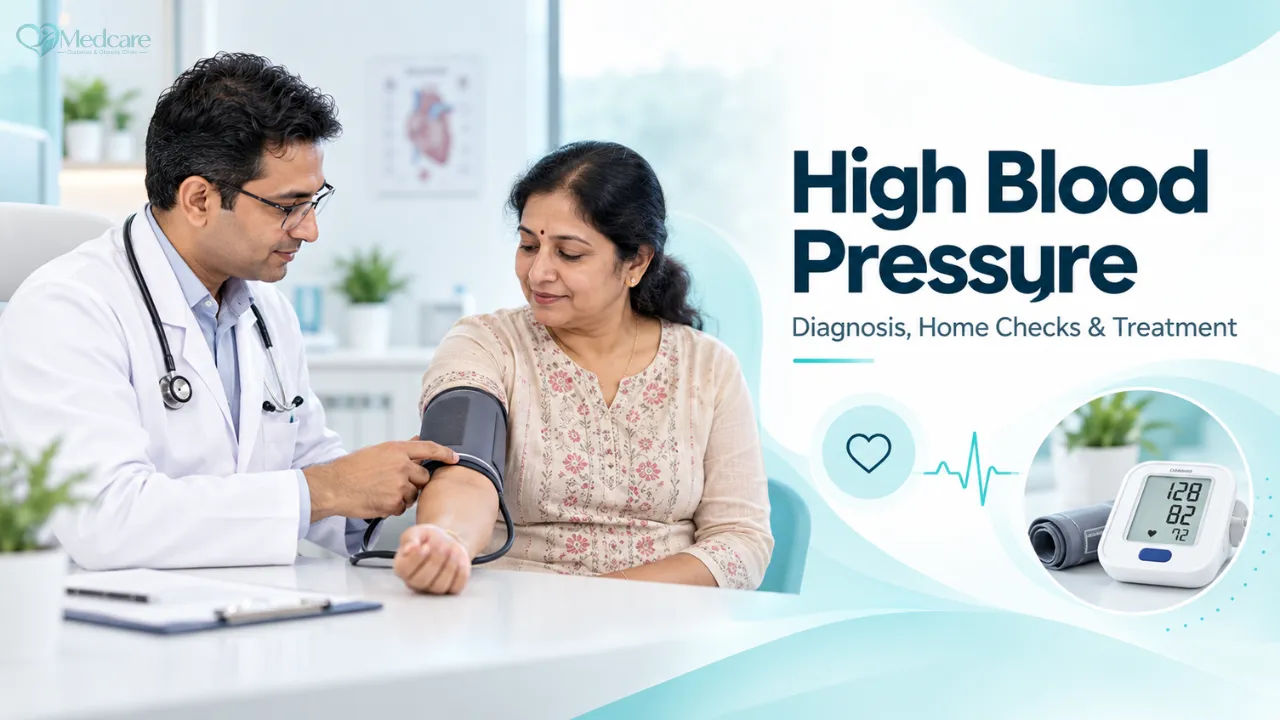
Your BP report shows two numbers, such as 128/82 mmHg. The top number (systolic pressure) is measured while the heart squeezes. The bottom number (diastolic pressure) is measured as it relaxes between beats.
Both count. After the age of 50 it is usually the top number that climbs more and causes more concern.
Primary and secondary hypertension
In most adults no single cause is found. This is called primary or essential hypertension, and it develops slowly as age, family history, weight, salt, inactivity and poor sleep add up.
In a smaller number of people, something else is pushing the BP up. Doctors call this secondary hypertension. Kidney disease, sleep apnea, thyroid problems, hormone problems of the adrenal glands and certain medicines are the usual culprits. When the cause is found and treated, BP often becomes much easier to control.
What is a normal blood pressure reading?
In most adults, a clinic reading under 120/80 mmHg is normal. Anything from 120/80 up to 139/89 mmHg sits above the ideal, and you may see it called "elevated", "high normal" or "borderline" depending on which guideline your doctor follows. A reading of 140/90 mmHg or more on separate visits is generally diagnosed as hypertension.
The labels vary a little between guideline bodies. The number on your report, and your overall heart risk, matter more than the name.
| Category | Clinic reading (mmHg) | What it usually means |
|---|---|---|
| Normal | Below 120/80 | Keep healthy habits and check at least once a year |
| Elevated or borderline | 120/80 to 139/89 | Lifestyle changes, more frequent checks, look at other risks |
| High BP (hypertension) | 140/90 or above, on repeat | Needs a medical assessment and a treatment plan |
| Very high | 180/120 or above | See a doctor the same day, or call 108 or 112 if you have symptoms |
Home and 24-hour readings have their own cut-offs
You are usually more relaxed at home than in a clinic, and your BP reflects that. For this reason the limits for home and 24-hour readings are set lower.
| Type of measurement | Usually considered high (mmHg) |
|---|---|
| Clinic reading | 140/90 or above |
| Home BP average | 135/85 or above |
| 24-hour average | 130/80 or above |
| Daytime average (24-hour monitor) | 135/85 or above |
| Night-time average (24-hour monitor) | 120/70 or above |
Does normal BP change with age?
BP does tend to rise as we get older, mainly because the arteries stiffen. But a higher reading at 65 is still a risk, not a normal part of ageing. Someone at 150/90 mmHg has a higher chance of stroke and heart disease than someone of the same age at 125/80 mmHg.
Age affects the target rather than the definition. For an older or frail person, the doctor may accept a slightly higher target so that treatment does not cause dizziness or falls.
Why does high blood pressure happen?
Usually several things are at work together. Your risk goes up if a parent had high BP, and it rises steadily after 40. Weight gain, particularly around the belly, is a big contributor. So is a sedentary day spent mostly sitting.
Salt deserves its own mention. In many homes in Lower Assam it comes not only from cooking but from pickles, dried and fermented fish, papad, chanachur, instant noodles, packaged snacks and the pinch of raw salt kept on the side of the plate to mix with rice. Taken together, that adds up to a lot more than most people realise.
Other common contributors are:
- tobacco in any form, whether cigarettes, bidi, gutkha, khaini or tobacco in paan
- regular drinking, including rice beer and country liquor
- poor sleep, and especially sleep apnea, where loud snoring comes with pauses in breathing
- diabetes and kidney disease
- stress that goes on for months
- certain medicines, such as regular painkillers like ibuprofen or diclofenac, steroids, some cold and flu remedies and some hormone pills
What are the symptoms of high blood pressure?
There usually aren't any. Plenty of people carry high BP for years without knowing, and it turns up at a routine check, before surgery or, sadly, after a stroke or heart attack.
When BP is very high, some people get a morning headache at the back of the head, dizziness, blurred vision, a nosebleed, breathlessness, chest discomfort or a pounding sensation in the chest or neck. These signs cannot be trusted to tell you your BP. Many people with dangerously high readings feel nothing, while headaches are just as common in people whose BP is normal. The only way to know your BP is to check it.
After 30, have your BP checked whenever you see a doctor, even if the visit is for something unrelated.
Why is high blood pressure harmful?
High pressure, kept up for years, damages the lining of blood vessels everywhere in the body. The damage shows up in different places in different people.
In the brain it can lead to a stroke, and in later life to memory problems. In the heart it raises the risk of heart attack and of an irregular rhythm called atrial fibrillation. The heart muscle also thickens to cope with the extra load, and over time a thick, stiff heart can turn into heart failure. The kidneys slowly lose function, sometimes to the point of failure. The small vessels at the back of the eye can be damaged too.
Higher BP and more years of it mean higher risk. Lowering it cuts that risk, even in someone who has had high BP for a long time.
How is high blood pressure diagnosed?
No doctor should diagnose hypertension from one reading. BP moves up and down through the day, and it jumps with anxiety, pain, a full bladder, a cup of tea, a cigarette or a rushed walk from the bus stop to the clinic.
Proper readings in the clinic
The reading should be taken after you have sat quietly for a few minutes, with a cuff of the right size on your bare upper arm. Two or three readings are usually taken and averaged. Unless the reading is very high, it is repeated on another day before a diagnosis is made.
Readings away from the clinic
Home readings or a 24-hour ambulatory BP monitor (ABPM) show what your BP does in ordinary life, which is often quite different from what it does in a doctor's room.
With ABPM, you wear a cuff on your arm linked to a small recorder on your belt. It inflates on its own, every 15 to 30 minutes in the day and less often at night, while you carry on with your normal routine and sleep at home. The test is particularly useful before committing someone to lifelong treatment, for spotting white-coat and masked hypertension, for checking that BP falls at night as it should, and for seeing whether medicines are covering the whole 24 hours.
Tests that look for causes and damage
Once the diagnosis is confirmed, the next questions are why the BP is high and whether it has already affected any organs. A urine test for protein can show early kidney strain. Blood tests check kidney function (creatinine and eGFR), sodium and potassium, blood sugar or HbA1c and the lipid profile. An ECG looks at the heart's rhythm and for signs of thickened muscle.
Depending on the situation, your doctor may also suggest an echocardiogram (an ultrasound scan of the heart), an eye examination, a thyroid test or other hormone tests.
White-coat, masked and night-time hypertension
Clinic readings miss three common patterns.
White-coat hypertension
Some people's BP is high in the clinic and normal at home, simply from the tension of the visit. This is common, and it is one reason doctors like to see home or 24-hour readings before starting tablets. It still needs watching, because a fair number of people with this pattern develop true high BP later.
Masked hypertension
Here it works the other way round. The clinic reading looks fine, yet BP is high at home or through the working day. Because it hides so well, it is easy to miss. It turns up more often in smokers, people who drink, those with diabetes or kidney disease and people under heavy work pressure.
Night-time (nocturnal) hypertension
Healthy BP drops during sleep. In some people it doesn't, and in a few it even rises at night. People with diabetes, kidney disease or sleep apnea are more prone to this. A 24-hour monitor is the only way to pick it up.
How do you check blood pressure at home correctly?
Home readings are only as good as the way they are taken. A cuff that is too small, or a reading taken straight after climbing the stairs, can be many points off.
Picking a machine
Buy an automatic machine that uses a cuff on the upper arm. For most people, wrist and finger devices are less reliable. Choose a model that has been clinically validated, and ask your doctor if you are unsure. Check the cuff size against your arm, because a cuff that is too tight gives falsely high readings, and people with larger arms often need a large cuff. It also helps to bring the machine along to a clinic visit once so its readings can be compared with the clinic's.
Getting ready
For half an hour beforehand, skip tea, coffee, smoking, tobacco and exercise. Use the toilet first. Then sit quietly on a chair with a back rest for 5 minutes.
Taking the reading
- Keep your back against the chair and both feet flat on the floor, legs uncrossed.
- Rest your arm on a table so that the cuff sits at the level of your heart.
- Put the cuff on bare skin, 2 to 3 cm above the bend of the elbow. A rolled-up sleeve or sweater underneath will spoil the reading.
- Stay silent and keep the phone away while the cuff inflates.
- Take 2 readings with a 1-minute gap.
- Note both readings with the date and time, or let the machine store them.
How often to check
When BP has just been found high, or a medicine has just been changed, doctors commonly ask for readings morning and evening for 7 days. Take the morning reading before breakfast and before your tablets, and the evening one before dinner, 2 readings each time. Your doctor will usually set aside the first day and average the rest.
Once things are steady, a few readings a week is usually plenty, unless your doctor asks for more. Checking again and again through the day mostly breeds worry.
If you get one high reading, sit down, rest 5 minutes and check again. Write it down and show your doctor rather than taking an extra tablet on your own.
How is high blood pressure treated?
Treatment rests on changes to daily habits and, for many people, medicines alongside them. The point is not just a better number on the machine. It is fewer strokes, heart attacks and kidney problems in the years ahead.
What BP target should you aim for?
For many adults the aim is a clinic reading below 130/80 mmHg, provided it can be reached without side effects. In older people, frail people, or anyone who gets dizzy on standing up, the target may be relaxed. Your doctor will agree a target with you based on your age, your other conditions and how you feel on treatment.
Who needs medicines?
That depends on how high the BP is and on what else is going on. A person with borderline readings and few other risks may be given a few months to bring BP down through lifestyle change alone. Someone with clearly high readings, or with diabetes, kidney disease, heart disease, a previous stroke, protein in the urine or a thickened heart muscle, will usually start medicine straight away, together with the lifestyle changes.
What can you do at home to lower blood pressure?
These steps lower BP on their own in many people, and they help the medicines do their job.
Use less salt
Salt (sodium) makes the body hold on to water, and that raises the pressure. The WHO recommends that adults keep total salt under 5 g a day, roughly one level teaspoon, and that includes the salt already in food.
The single easiest change is to stop putting extra salt on the plate with your rice. After that, cut back gradually on salt in dal, sabzi and fish curry. Food tastes bland for the first couple of weeks, and then your taste adjusts. Pickles, dried fish, fermented fish, papad and namkeen are best kept for the odd occasion. Instant noodles, chips, bhujia and chanachur are some of the saltiest foods on the shelf. Lemon, garlic, ginger, mustard, coriander and local herbs give plenty of flavour without the sodium. On packaged food, look for the sodium figure on the label.
Low-sodium salt substitutes contain potassium. They help some people but can be harmful in kidney disease and with certain BP medicines, so ask your doctor before switching.
Change what goes on the plate
More vegetables, seasonal fruit and dal, and less fried and packaged food, lowers BP for many people. Fish, eggs and lean meat in sensible amounts are fine. A simple rule is to fill half the plate with vegetables and keep the rice portion moderate.
Lose some weight if you need to
Even a few kilos lost can bring BP down, especially when the weight has gathered around the waist. Slow, steady loss from changes in meals and activity tends to last better than a crash diet. If you have struggled on your own,medical weight management may help.
Keep moving
Try for around 30 minutes of brisk walking on most days, or about 150 minutes a week in total. Cycling, yoga, work in the garden or field and taking the stairs all count. If you sit for long hours, get up and move every so often. People with heart disease or very high readings should check with their doctor before taking up hard exercise.
Give up tobacco, cut down alcohol
Every form of tobacco raises BP and damages the arteries, and that includes gutkha, khaini and tobacco in paan. Quitting is among the best things you can do for your heart. Regular drinking, rice beer included, also pushes BP up. Drinking less helps, and for many people not drinking at all is better still.
Sleep properly
Most adults need 7 to 8 hours. Loud snoring, someone noticing that you stop breathing in your sleep, or feeling sleepy through the day all point towardssleep apnea. Treating it often makes BP easier to manage.
Deal with stress
Walking, prayer, slow breathing, time with family and decent sleep help a lot of people. Stress on its own rarely causes lasting high BP, but it can make control harder.
Change one habit, get used to it, then start the next. Taking the salt off the plate is a good first step, and a daily walk can come after.
Which medicines are used for high blood pressure?
BP medicines have been used for decades and studied in very large numbers of people. Under a doctor's supervision they are safe to take long term. Which one you get depends on your age, your other conditions, your kidney function and how you tolerate it.
| Medicine group | How it works (simply) | Often chosen when |
|---|---|---|
| ACE inhibitors | Relax the blood vessels by blocking a hormone that narrows them | Diabetes, kidney disease, heart failure |
| Angiotensin receptor blockers (ARBs) | Work much like ACE inhibitors | The same situations, or when an ACE inhibitor causes a cough |
| Calcium channel blockers | Relax the muscle in artery walls | Many adults, including older people |
| Thiazide-type diuretics | Help the kidneys get rid of extra salt and water | Many adults, often along with another medicine |
| Beta blockers | Slow the heart and ease its workload | After a heart attack, with some rhythm problems, in heart failure |
It is quite normal to need 2 medicines or more to reach the target, and it does not mean your BP is especially bad. Doctors often put 2 medicines into one tablet so there is less to remember each day.
What side effects can BP medicines cause?
Most people have none. In the early weeks some feel dizzy when they stand up quickly. ACE inhibitors can cause a dry cough, some calcium channel blockers cause ankle swelling, and diuretics mean more trips to the toilet. Some medicines also shift potassium or kidney test results, which is why blood tests are repeated from time to time.
If something bothers you, tell your doctor. There is almost always another medicine to try. Please don't stop a tablet without speaking to them first.
Planning a pregnancy
ACE inhibitors and ARBs are among the BP medicines that are not used in pregnancy. If you have high BP and are planning a baby, or might already be pregnant, let your doctor know early so your treatment can be switched safely.
What is resistant hypertension?
When BP stays above target on 3 different medicines at proper doses, one of them a diuretic, doctors call it resistant hypertension. True resistant hypertension is less common than it looks, because there is often another explanation.
Doses may be getting missed or taken at odd times. The home machine may be inaccurate, or the technique may be off. The clinic readings may be inflated by the white-coat effect, which a 24-hour monitor can sort out. A high salt intake can quietly undo the work of the medicines, and so can regular painkillers or steroids. Alcohol and tobacco play a part in some people. And sometimes there is an underlying cause, such as sleep apnea, kidney disease or an adrenal gland that makes too much of the hormone aldosterone.
Once these are found and dealt with, BP often comes under control without piling on more tablets. A few people need referral for further tests.
Common myths about high blood pressure
"I feel fine, so my BP must be fine." Feeling well tells you nothing about your BP. Most people with high BP feel completely normal.
"Once you start BP tablets you can never stop, they are addictive." BP medicines are not addictive. People take them for years because high BP lasts for years, in the same way people keep wearing glasses for poor eyesight. Some who lose weight and change their habits are able to cut down, but that should only be done with their doctor.
"BP tablets damage the kidneys." Uncontrolled BP is one of the leading causes of kidney damage. In most people the medicines protect the kidneys, and blood tests are done to check that each medicine suits you.
"My BP is normal now, so I don't need the tablet." A normal reading on treatment usually means the tablet is doing its job. Stop it and the BP generally climbs back, sometimes fast.
"Garlic or bottle gourd juice will fix it." Good food helps BP, but no home remedy has been shown to take the place of medicine when medicine is needed. Some juices and herbal mixtures can also interfere with tablets.
"High BP is an old person's problem." More and more people in their 20s and 30s are being diagnosed, often alongside weight gain, tobacco, alcohol and poor sleep.
How is high BP linked to diabetes, weight and the heart?
High BP seldom comes alone. It tends to turn up with diabetes, high cholesterol, a large waist, fatty liver and sleep apnea, and each one adds to the risk of heart disease and stroke.
Diabetes and high BP both harm the tiny blood vessels of the kidneys and eyes, so when a person has both, protecting the kidneys becomes a big part of treatment. You can read more on ourdiabetes care page. Weight and BP move together, and losing weight often brings down BP and blood sugar at once. The heart, after years of working against high pressure, thickens its main pumping wall (left ventricular hypertrophy) and may later stiffen and fail. An echo can show these changes early, often long before there are symptoms.
So looking after BP well means looking at all of these together.
When should you see a doctor?
Book a visit if you have never had your BP checked or it has been more than a year, or if a reading at home or at a pharmacy comes to 140/90 mmHg or more. A home average of 135/85 mmHg or above also needs a review. So does high BP alongside diabetes, kidney disease or high cholesterol, BP that stays high in spite of medicines, side effects from your tablets, feeling dizzy or faint when you stand up on treatment, and high BP in someone who is pregnant or planning a pregnancy.
Emergency signs
If your BP is 180/120 mmHg or higher and you also have any of the following, call 108 or 112 or go to the nearest emergency department straight away:
- chest pain or pressure
- severe breathlessness
- a sudden, severe headache
- confusion or unusual drowsiness
- weakness, numbness or drooping on one side of the face or body
- trouble speaking or understanding speech
- sudden blurring or loss of vision
If the reading is that high but you feel well, rest for 5 minutes and measure again. If it is still 180/120 mmHg or more, contact your doctor the same day.
At Medcare
At Medcare in Bongaigaon, Dr. Das confirms high BP with careful clinic readings and, where it helps,24-hour ambulatory BP monitoring before any long-term treatment is decided. ECG,echocardiography and HbA1c are done at the clinic, and the results are explained in plain words at the same visit. BP is looked at together with sugar, weight, sleep and the heart, and the plan is fine-tuned over follow-up visits. Please bring your home BP notebook or machine when you come.
You can request a time through theappointment page.
Key takeaways
- High BP rarely causes symptoms, so checking it regularly is the only way to catch it.
- A diagnosis needs repeated readings, ideally backed by home checks or a 24-hour monitor.
- At home, an average of 135/85 mmHg or higher is usually treated as high.
- Cutting salt, losing some weight, walking daily, quitting tobacco and sleeping well all lower BP.
- BP medicines are not addictive, they protect the heart and kidneys, and they should only be stopped on your doctor's advice.
- A reading of 180/120 mmHg or more with chest pain, breathlessness, weakness or confusion needs emergency care through 108 or 112.
FAQs
Is 140/90 high blood pressure?
Generally, yes. If your clinic reading is 140/90 mmHg or higher on more than one occasion, that is usually diagnosed as high blood pressure. One reading on its own isn't enough, since stress, pain and activity can all push BP up for a while. Most doctors will want home readings or a 24-hour BP monitor to confirm it before starting treatment.
Can high blood pressure be cured permanently?
In most people it can't be cured, but it can be kept well under control. Primary hypertension, the most common kind, is long term. Weight loss, less salt, stopping tobacco and regular exercise sometimes allow fewer tablets, and occasionally none. When there is a specific cause, such as sleep apnea or a hormone problem, treating that cause can sometimes bring BP back to normal.
Which arm should I use to check BP at home?
Use whichever arm gave the higher reading when your doctor checked both. A small difference between the two arms is normal. Sticking to the same arm keeps your home records comparable over time. Make sure the cuff is the right size, sits on bare skin and rests at about the level of your heart.
Can I stop my BP tablet if my readings are normal?
Please don't stop it on your own. Normal readings while you are on treatment usually mean the tablet is working, and BP tends to climb again once it is stopped, sometimes quickly. If your readings are running low or you feel dizzy, take your home records to your doctor. They may lower the dose or change the medicine safely.
Can tea or coffee raise blood pressure?
They can, but only for a few hours. The caffeine in tea and coffee gives a short rise in BP, more so in people who rarely drink it. For most people with high BP, a few cups a day is fine. Leave a 30-minute gap before you measure, and go easy on the sugar in your tea if you also have diabetes or are trying to lose weight.
Can young people get high blood pressure?
They can, and it is becoming more common in people in their 20s and 30s. Weight gain, tobacco, alcohol, salty food, little exercise and poor sleep are often behind it. In a young person, though, doctors also look carefully for an underlying cause such as kidney or hormone disease, because treating that cause can change the outlook.
Sources
Sources
- NHS: Blood pressure test
- NICE guideline NG136: Hypertension in adults
- [WHO fact sheet: Cardiovascular diseases](https://www.who.int/news-room/fact-sheets/detail/cardiovascular-diseases-(cvds))

Medically reviewed by Dr. Tamoghna Das, MBBS, MD (Medicine) · Assam Council of Medical Registration No. 20276 · Last reviewed 9 October 2026
Medical disclaimer. This article is for general information only. It is not a diagnosis and is not a substitute for a consultation with a doctor. For advice about your own health, please book an appointment. Read our medical disclaimer.
Seek urgent care now, call 108 or 112, or go to the nearest emergency department if you have chest pain, sudden breathlessness, fainting, weakness on one side of the body, very high blood sugar with vomiting or drowsiness, repeated low blood sugar with confusion, or a foot wound with redness, swelling or fever.