
Stress Echocardiogram: What It Is and When It's Needed
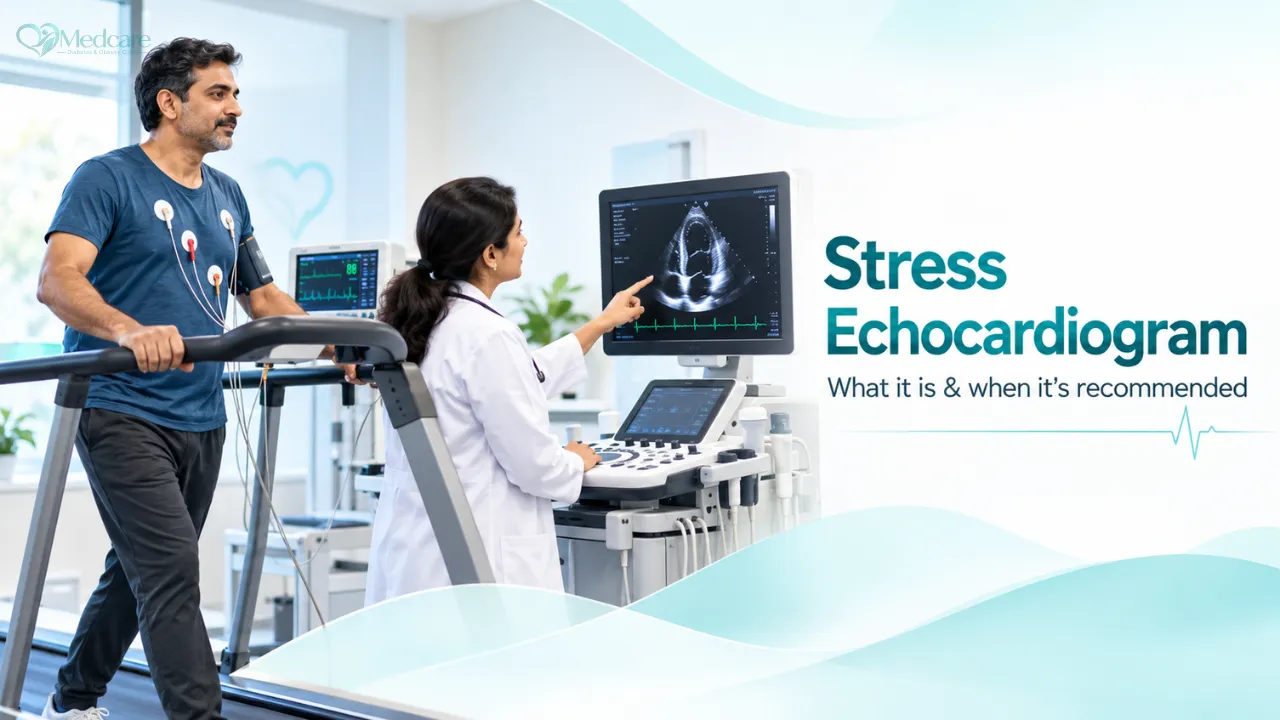
A stress echocardiogram (stress echo) is a test that uses ultrasound to see how your heart muscle works at rest and under stress, usually during exercise on a treadmill or bicycle, or with a medicine that makes the heart work harder. It helps detect reduced blood flow to parts of the heart caused by narrowed coronary arteries.
Quick answer
- A stress echo compares heart images before and after stress.
- If part of the heart muscle does not move well under stress, it may mean that area is not getting enough blood.
- It is recommended for chest discomfort, breathlessness on exertion, abnormal ECG findings, assessing known heart disease and, in some cases, before major surgery.
- It is non-invasive and uses no radiation.
How Does It Work?
At rest, the heart may receive enough blood even with partly blocked arteries. During stress, the heart needs more oxygen. If an artery is narrowed, the area it supplies may not pump normally. The echo detects these changes.
Types of Stress Echo
Exercise stress echo
You walk on a treadmill or ride a bicycle while the heart rate increases. Images are taken before and immediately after exercise.
Dobutamine stress echo
For people who cannot exercise, a medicine called dobutamine is given through a vein to make the heart beat faster and harder.
When Is It Recommended?
- Chest pain or discomfort, especially with exertion
- Breathlessness on exertion
- Abnormal ECG or treadmill test
- Assessing known coronary artery disease
- Checking heart function before major surgery in selected patients
- Evaluating some valve problems
- People with diabetes and symptoms suggesting heart disease
How to Prepare
- Avoid heavy meals for a few hours before the test
- Avoid caffeine on the day if advised
- Wear comfortable clothes and walking shoes
- Ask your doctor whether to stop any heart medicines, such as beta-blockers
- Bring a list of current medicines
- Plan for the test to take about an hour
What Happens During the Test?
-
ECG electrodes are placed on your chest
-
Resting echo images are taken
-
You exercise or receive dobutamine under supervision
-
Heart rate, BP and ECG are monitored throughout
-
Echo images are taken at peak stress
-
You rest while heart rate returns to normal
Is It Safe?
Stress echo is generally safe when performed under medical supervision. Some people feel tired, breathless or have palpitations during the test. Serious complications are rare. The team will stop the test if needed.
What Do Results Mean?
- Normal result: heart muscle moves well at rest and under stress
- Abnormal result: some areas do not move well under stress, suggesting reduced blood supply
- Further tests, such as coronary angiography, may be advised based on results
Key Takeaways
- Stress echo shows how the heart works under stress.
- It helps detect reduced blood flow.
- Exercise or medicine can be used.
- It is non-invasive and radiation-free.
- Results guide further tests or treatment.
Final Thoughts
A stress echo provides valuable insight into heart health, especially when symptoms appear with activity. It helps your doctor plan the right next step. For stress echo and cardiac evaluation, you can consult Dr. Tamoghna Das, an internal medicine and cardio-diabetology specialist at Medcare Diabetes & Obesity Clinic.
This article is part of our guide to ECG vs 2D echo, written for patients and families in Bongaigaon.
FAQs
How is a stress echo different from a TMT?
A TMT (treadmill test) records only the ECG during exercise. A stress echo adds ultrasound images of the heart, giving more detailed information about how the heart muscle moves under stress.
Is a stress echo safe?
Yes, it is generally safe under supervision. You may feel tired or breathless. Serious problems are rare, and trained staff monitor you throughout the test.
What if I cannot walk on a treadmill?
A dobutamine stress echo can be done instead. The medicine increases heart rate and workload while you lie down, so exercise is not needed.
Should I stop my medicines before a stress echo?
Some medicines, like beta-blockers, may need to be paused. Only stop medicines if your doctor advises it. Always follow specific instructions given before the test.
How long does a stress echo take?
The whole process usually takes about 45 minutes to an hour, including preparation, the test and recovery time.
What happens if my stress echo is abnormal?
An abnormal result may suggest reduced blood flow to part of the heart. Your doctor may recommend further tests, such as coronary angiography, and discuss treatment options.
Sources

Medically reviewed by Dr. Tamoghna Das, MBBS, MD (Medicine) · Assam Council of Medical Registration No. 20276 · Last reviewed 20 October 2026
Medical disclaimer. This article is for general information only. It is not a diagnosis and is not a substitute for a consultation with a doctor. For advice about your own health, please book an appointment. Read our medical disclaimer.
Seek urgent care now, call 108 or 112, or go to the nearest emergency department if you have chest pain, sudden breathlessness, fainting, weakness on one side of the body, very high blood sugar with vomiting or drowsiness, repeated low blood sugar with confusion, or a foot wound with redness, swelling or fever.