Sleep Apnea and Metabolic Health: Diabetes, BP and Weight
In brief
- Obstructive sleep apnea (OSA) is a condition in which the throat closes repeatedly during sleep, so breathing stops or becomes very shallow many times a night.
- Typical signs are loud snoring, breathing pauses noticed by a family member, gasping at night and sleepiness during the day.
- OSA is more common in people with type 2 diabetes, high blood pressure and obesity, and when untreated it may make sugar and BP harder to control.
- The diagnosis is made with a sleep study. Most adults can do this at home with a small device worn for one night.
- Moderate and severe OSA is usually treated with a CPAP machine, together with weight management and avoiding alcohol and sleeping pills at night.
- A person who snores loudly and has diabetes, high BP or excess weight should ask their doctor whether a sleep study is needed.
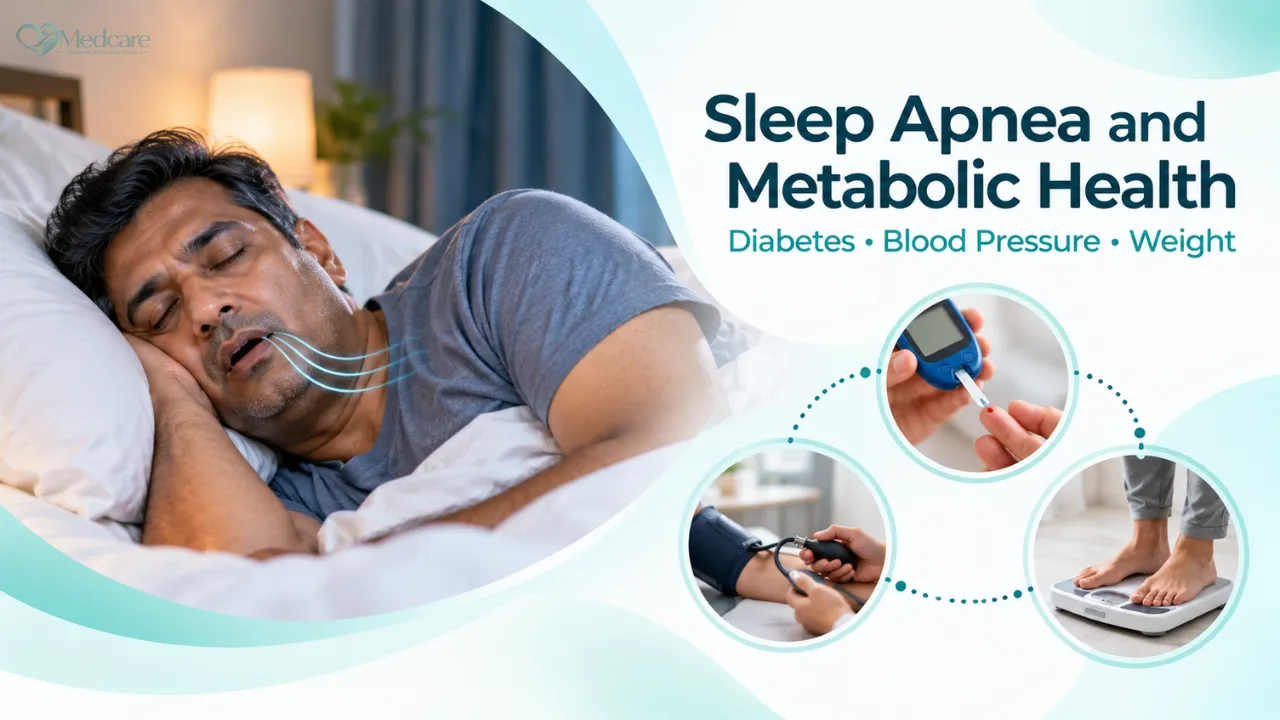
Obstructive sleep apnea is a breathing disorder that happens during sleep. The airway at the back of the throat closes, the oxygen level in the blood falls, and the brain wakes the person for a few seconds so that breathing can restart. In severe cases this may happen more than a hundred times in a night, usually without the person remembering it. The effects are felt the next day as tiredness, and over a longer period they may show up in blood sugar, blood pressure and body weight. This connection between sleep apnea and metabolic health is the reason sleep is worth asking about during diabetes and BP check-ups in Bongaigaon and the rest of Lower Assam.
What is obstructive sleep apnea?
In obstructive sleep apnea, or OSA, the soft tissues at the back of the throat relax during sleep and block the airway. The chest and belly continue to make breathing movements, but little or no air reaches the lungs.
Doctors describe two kinds of events. An apnea is a complete pause in breathing that lasts at least 10 seconds. A hypopnea is a period of very shallow breathing that lowers the oxygen level.
The throat in sleep apnea behaves somewhat like a soft drinking straw. If you suck hard through a soft straw, its walls fold inwards. During sleep the throat muscles lose their tone, and the airway can fold in the same way.
Is sleep apnea the same as snoring?
No. Snoring is the sound made when air passes through a narrowed throat and vibrates the soft tissues. In sleep apnea, the narrowing is severe enough to stop or greatly reduce the airflow.
Many people snore without having sleep apnea. Snoring needs a medical check when it is loud, happens on most nights, or comes with breathing pauses, gasping or daytime tiredness.
Are there other types of sleep apnea?
Central sleep apnea is a less common type. The airway stays open, but the brain does not send a regular signal to breathe. It is seen in some people with heart failure, after a stroke, or in those taking strong painkillers. This article deals with obstructive sleep apnea, which is the type found in most adults.
What causes sleep apnea?
Sleep apnea develops when the airway in the throat is narrow or floppy enough to close during sleep. In most people several factors are involved.
Excess weight is the most common one. Fat around the neck presses on the airway, and belly fat reduces lung volume when a person lies flat. A neck size above about 43 cm (17 inches) in men or about 40 cm (16 inches) in women is often used as a warning sign.
The structure of the face and mouth also plays a part. A small or set-back lower jaw, a large tongue or enlarged tonsils can narrow the airway in people of normal weight. South Asians may develop sleep apnea at a lower body weight than people of European origin, so a normal or near-normal weight does not rule it out.
Other factors that raise the risk include the following.
- Older age, since throat muscles become less firm
- Male sex, although the risk in women increases after menopause
- Alcohol or sleeping pills taken in the evening, which relax the throat muscles
- Smoking, which causes swelling in the airway
- A nose that is often blocked because of allergy or a bent nasal wall (deviated septum)
- Sleeping on the back
- An underactive thyroid (hypothyroidism), polycystic ovary syndrome (PCOS) and heart failure
What are the signs and symptoms?
Some symptoms happen during sleep and are usually noticed by a spouse or another family member. Others appear during the day.
| Signs during the night | Signs during the day |
|---|---|
| Loud snoring on most nights | Tiredness after 7 or 8 hours in bed |
| Breathing pauses noticed by someone else | Falling asleep while reading, watching TV or travelling by bus |
| Waking up gasping, choking or snorting | Drowsiness while driving |
| Restless, broken sleep | Headache in the morning |
| Waking several times to pass urine | Dry mouth or sore throat on waking |
| Sweating at night | Poor concentration, forgetfulness, irritability |
| Waking with a fast heartbeat | Low mood and reduced interest in sex |
Why do I feel sleepy after a full night in bed?
When the airway closes 20 or 30 times an hour, the brain is roused out of deep sleep each time. A person may spend 8 hours in bed and still get very little deep, restful sleep. For this reason many people with sleep apnea wake up feeling unrefreshed.
Can someone have sleep apnea without feeling sleepy?
Yes. Some people, particularly those with long-standing diabetes, heart disease or high BP, report only mild tiredness or low energy. A few have no daytime symptoms. Doctors therefore consider sleep apnea in people whose BP remains high on treatment or whose fasting sugar stays high without an obvious cause, even if they say they sleep well.
A family member can record 2 or 3 minutes of your snoring on a mobile phone. The recording helps the doctor judge whether there are pauses in breathing.
Sleep apnea in women
Women with sleep apnea are less likely to report loud snoring. Common complaints are poor sleep, tiredness, morning headaches, anxiety or low mood. The risk rises after menopause and in women with PCOS, and the condition is more often missed in women for these reasons.
Sleep apnea in children
Children can also have sleep apnea, most often because of enlarged tonsils or adenoids. Signs include snoring on most nights, breathing through the mouth, restless sleep, bedwetting after the child had become dry at night, and difficulty paying attention at school. A child with these signs should be seen by a paediatrician or an ENT specialist.
How is sleep apnea linked to metabolic health?
Metabolic health refers to how well the body controls blood sugar, blood fats, blood pressure and body weight. Sleep apnea affects each of these.
During every breathing pause the oxygen level drops and the body releases stress hormones such as adrenaline, which rouse the person enough to breathe again. When this repeats night after night for months or years, the body remains under constant stress. Blood vessels become stiffer, insulin becomes less effective, appetite changes and the heart works harder.
| Condition | Possible effect of untreated sleep apnea |
|---|---|
| High blood pressure | Higher BP at night and during the day, and loss of the normal fall in BP during sleep |
| Type 2 diabetes and prediabetes | Greater insulin resistance and higher stress hormones, making sugar harder to control |
| Obesity | Changes in hunger and fullness signals, and less energy for physical activity |
| Heart disease | Extra strain on the heart, with links to irregular heartbeat, heart failure and coronary artery disease |
| Fatty liver | Frequently present at the same time, as both are associated with insulin resistance and excess weight |
| Stroke | Higher risk, partly through high BP and irregular heartbeat |
Sleep apnea and high blood pressure
Sleep apnea is a recognised cause of high blood pressure that is difficult to control. In healthy people, BP falls by about 10 to 20% during sleep. In many people with sleep apnea this fall does not occur, and in some the night-time BP is higher than the daytime reading.
Night-time BP is closely related to the future risk of heart attack and stroke. Doctors may suspect sleep apnea when BP is above target despite 3 or more medicines, or when readings are highest in the early morning. A 24-hour ambulatory BP test, in which a small cuff measures BP at intervals through the day and night, can show this pattern. Further information is available on the page abouthigh blood pressure care.
Sleep apnea and diabetes
Sleep apnea is common in people with type 2 diabetes. The American Diabetes Association recommends that doctors consider screening for it in people with diabetes who have loud snoring, daytime sleepiness or breathing pauses observed by others.
Low oxygen and repeated stress responses reduce the body's sensitivity to insulin. Broken sleep also raises cortisol, a hormone that increases blood sugar in the early morning hours. As a result, fasting sugar may remain high even when diet and medicines are being followed. Diabetes can in turn affect the nerves that control breathing and the throat muscles, which may worsen sleep apnea.
When morning sugar readings are difficult to explain, sleep should be reviewed as part ofdiabetes care.
Sleep apnea and body weight
Excess weight narrows the airway, and poor sleep makes weight loss more difficult. Short and broken sleep increases hunger, particularly for sweet and fried food, and reduces the energy available for exercise the next day.
People with untreated sleep apnea often find it hard to lose weight. After treatment, many report more energy during the day and fewer late-night food cravings. Weight loss also reduces the number of breathing pauses, and in some people the improvement is substantial. The approach used at Medcare is described on theweight management page.
Sleep apnea and the heart
Each pause in breathing is followed by a fall in oxygen and a rise in BP, both of which affect the heart. Sleep apnea is associated with atrial fibrillation (an irregular heartbeat), heart failure and coronary artery disease. In people whose atrial fibrillation returns after treatment, doctors commonly look for sleep apnea.
Palpitations at night should be reported to a doctor. AHolter monitor, worn for 24 hours or longer, records the heart rhythm during normal daily activity and sleep.
Sleep apnea and the thyroid
An underactive thyroid can cause swelling of the tongue and throat tissues, weight gain and tiredness, and each of these may contribute to sleep apnea. A thyroid blood test is often included in the assessment.
Who should be checked for sleep apnea?
Snoring is common and is not always a concern. A check for sleep apnea is advisable when loud snoring occurs along with any of the following.
- Type 2 diabetes or prediabetes, particularly with poor sugar control
- High BP that needs several medicines or is highest in the morning
- Obesity or a large neck size
- Atrial fibrillation, heart failure or a previous stroke
- Daytime sleepiness, morning headaches or poor concentration
- Breathing pauses or gasping observed by family members
- PCOS or an underactive thyroid
Doctors often begin with a short questionnaire. The STOP-BANG questionnaire covers snoring, tiredness, observed pauses, BP, body mass index (BMI), age, neck size and gender. The Epworth Sleepiness Scale measures how likely a person is to fall asleep in common daily situations. These tools help identify who needs a sleep study, but they cannot confirm or exclude the diagnosis.
How is sleep apnea diagnosed?
Sleep apnea is confirmed with a sleep study, which records breathing, oxygen level and heart rate during sleep.
Home sleep apnea test
Most adults can have the test at home. The device usually includes a soft belt around the chest, a sensor under the nose to measure airflow and a clip on the finger to measure oxygen. It is put on at bedtime, worn through the night and returned the next day.
A home test is suitable for adults who are likely to have moderate or severe sleep apnea and who do not have serious heart, lung or nerve disease. Because the person sleeps in their own bed, the recording usually reflects a normal night.
Full sleep study in a laboratory
A full overnight study, called polysomnography, is done in a sleep laboratory. In addition to breathing and oxygen, it records brain waves, eye and muscle movements and leg movements. It may be advised when a home test result is unclear, when another sleep disorder is suspected, or when there is significant heart or lung disease.
Understanding the report
The main figure in a sleep study report is the apnea-hypopnea index (AHI). It gives the average number of apneas and hypopneas per hour of sleep.
| AHI (events per hour) | Usual interpretation in adults |
|---|---|
| Fewer than 5 | Normal |
| 5 to 14 | Mild sleep apnea |
| 15 to 29 | Moderate sleep apnea |
| 30 or more | Severe sleep apnea |
The report also shows the lowest oxygen level during the night and the time spent at low oxygen. Treatment decisions take into account the symptoms and other health conditions as well as the AHI. A person with mild sleep apnea who is very sleepy, or who has heart disease, may still benefit from treatment.
On the night of a home sleep test, follow your usual routine, avoid alcohol and take your regular medicines unless your doctor has advised otherwise.
How is sleep apnea treated?
Treatment depends on the severity of sleep apnea, the symptoms and any other medical conditions. Most people need a combination of measures.
CPAP therapy
CPAP stands for continuous positive airway pressure. It is the most widely used and most thoroughly studied treatment for moderate and severe sleep apnea.
A CPAP machine is placed beside the bed and delivers a steady flow of air through a mask worn over the nose, or over the nose and mouth. The air pressure keeps the throat open during sleep.
With regular use, many people sleep better within a few days to a few weeks, and daytime sleepiness and morning headaches often improve. In people with resistant high BP who use CPAP on most nights, BP may fall modestly. The effect on blood sugar is less consistent across studies, so diabetes treatment continues alongside CPAP.
Early problems include dry mouth, a blocked or runny nose, air leaking from the mask and difficulty getting used to wearing it. These can often be corrected by changing the size or type of mask, adding a humidifier or adjusting the pressure. Most people find it easier after the first few weeks of regular use.
Weight management
In people with excess weight, weight loss is one of the most useful parts of treatment. A moderate reduction in weight may lessen snoring and the number of breathing pauses, and some people need less treatment afterwards. Others still require CPAP because of jaw structure, tonsil size or age.
A practical eating plan, regular physical activity and adequate sleep form the basis of weight management. In some people with obesity, a doctor may considerGLP-1 weight-loss medicines under medical supervision. These medicines are not suitable for everyone, and the amount of weight lost varies between individuals.
Oral appliances
A dentist can make a mouthguard that holds the lower jaw slightly forward during sleep and keeps the airway open. It may be used for mild to moderate sleep apnea or for people who are unable to use CPAP.
Sleeping position
Some people have breathing pauses mainly when lying on their back. For them, sleeping on the side may reduce the number of events. A firm pillow placed behind the back can help maintain this position.
Nose and throat treatment
Treating nasal blockage improves breathing through the nose and makes CPAP easier to use. Children with enlarged tonsils often improve after ENT surgery. In adults, surgery is considered only in selected cases.
Managing related conditions
Treatment of sleep apnea may make blood sugar and BP easier to control. Good control of sugar, BP, cholesterol and thyroid function protects the heart and blood vessels, which are also affected by sleep apnea. Dr. Das reviews these conditions together during follow-up.
What can you do at home?
The following steps may reduce snoring and support medical treatment. They are not a substitute for a medical assessment.
- Avoid alcohol in the evening, since it relaxes the throat muscles and prolongs breathing pauses.
- Take sleeping pills or sedatives only if prescribed by a doctor who is aware of your snoring, as many of these medicines worsen sleep apnea.
- Stop smoking. Chewing tobacco also harms the heart and blood vessels.
- Have an earlier and lighter dinner. A large rice meal late at night followed by lying down can worsen snoring and acid reflux. Finishing dinner 2 to 3 hours before bed, with a smaller portion of rice and more dal, vegetables, fish or eggs, may help.
- Limit sweetened tea in the evening, as it adds sugar and caffeine close to bedtime.
- Stay active on most days, for example with a brisk 30-minute walk or work in the field or garden.
- Sleep on your side if snoring is worse when lying on your back.
- Go to bed and wake up at about the same time each day.
- Use steam or saline nasal drops before bed if your nose is often blocked.
- During Bihu and Durga Puja, keep festival meals moderate in size and try not to change your sleep timings too much, as late heavy meals and late nights often worsen snoring and sugar levels.
Common myths about sleep apnea
Myth 1. Loud snoring is a sign of deep sleep
Loud snoring is a sign of a narrowed airway. When it occurs with pauses and gasping, sleep is being interrupted repeatedly.
Myth 2. Only overweight people get sleep apnea
Excess weight increases the risk, but people of normal weight can also have sleep apnea because of jaw shape, enlarged tonsils or a narrow airway.
Myth 3. Sleeping pills will treat the tiredness
Sleeping pills relax the throat muscles and may lengthen breathing pauses. The tiredness is caused by the airway problem, and treatment needs to address that.
Myth 4. CPAP has to be used for life once started
CPAP controls sleep apnea while it is being used. If the underlying cause improves, for example after considerable weight loss, a repeat sleep study can show whether CPAP is still required.
Myth 5. Sleep apnea is only a snoring problem
Untreated sleep apnea is associated with high BP, poor sugar control, heart rhythm problems and road accidents due to drowsiness.
Is sleep apnea a risk for drivers?
Yes. Untreated sleep apnea can cause sudden sleepiness while driving and increases the risk of road accidents. Truck, bus and taxi drivers, and people who drive long distances regularly, such as between Bongaigaon and Guwahati, are particularly affected.
Anyone who has fallen asleep or nearly fallen asleep while driving should avoid long drives until they have been assessed. Alertness usually improves after treatment.
When should you see a doctor?
Consult a doctor if you have any of the following.
- Loud snoring on most nights, particularly with pauses or gasping
- Sleepiness or tiredness during the day despite adequate time in bed
- High BP despite medicines, or BP that is highest in the morning
- High fasting sugar without a clear reason
- Morning headaches, memory problems or low mood along with poor sleep
- Falling asleep while driving or at work
- Waking at night with a fast heartbeat, or waking several times to pass urine
Emergency symptoms
Call 108 or 112, or go to the nearest hospital, if any of these occur.
- Chest pain or pressure, or pain spreading to the arm, jaw or back
- Severe breathlessness, especially at rest or when lying flat
- Choking at night that continues after waking
- Bluish or grey lips or face
- Sudden confusion, difficulty speaking, drooping of the face or weakness on one side of the body
At Medcare
Dr. Das assesses sleep apnea as part of the overall care of diabetes, BP, weight, thyroid and heart conditions. If symptoms suggest sleep apnea, asleep study that is worn at home and returned the next day can be arranged. Other tests done at Medcare, such as 24-hour ambulatory BP, HbA1c, ECG, echocardiography, Holter monitoring, spirometry and body composition analysis, may be advised depending on the clinical findings. The results are explained in plain language before treatment is planned.
Key takeaways
- Obstructive sleep apnea causes repeated closure of the throat during sleep, which lowers oxygen and disturbs sleep.
- Snoring with pauses or gasping, together with daytime sleepiness, should be assessed by a doctor. Some people have few symptoms.
- Sleep apnea occurs more often in type 2 diabetes, high BP and obesity, and may keep sugar and BP above target.
- The diagnosis is confirmed with a sleep study, which most adults can do at home.
- Treatment commonly includes CPAP, weight management and avoiding alcohol and sedatives at night, along with control of sugar and BP.
- To find out whether you need a sleep study,book an appointment with Dr. Das.
FAQs
Can sleep apnea cause high blood sugar?
It can contribute to it. Repeated drops in oxygen and the release of stress hormones during sleep reduce the body's response to insulin. Poor sleep also raises cortisol, which increases sugar in the early morning. Sleep apnea is seldom the only cause of high sugar, but it should be considered when fasting readings stay high without a clear reason in a person who snores loudly.
Is a home sleep test as reliable as a hospital sleep study?
For most adults, a home sleep test is reliable. It detects moderate and severe sleep apnea well in people who do not have significant heart, lung or nerve disease. If the result is borderline or another sleep disorder is suspected, the doctor may recommend a full overnight study in a sleep laboratory.
Will losing weight cure sleep apnea?
In some people it leads to a large improvement, though not in all. Weight loss reduces pressure on the airway and often lowers the number of breathing pauses. Some people then need less treatment, while others continue to need CPAP because of jaw structure, tonsil size or age. A repeat sleep study after significant weight loss shows the extent of improvement.
Does CPAP lower blood pressure?
It usually lowers BP slightly. Regular use on most nights prevents the repeated stress responses that raise BP during sleep. The reduction is generally modest and tends to be greater in people whose BP remains high on several medicines. BP medicines are usually continued, and the doctor reviews them based on later readings.
Can a thin person who snores loudly have sleep apnea?
Yes. Body weight is one of several risk factors. A small lower jaw, a large tongue, enlarged tonsils, a blocked nose, alcohol at night and age can all narrow the throat. South Asians may also develop sleep apnea at a lower weight. Loud snoring with pauses, gasping or daytime tiredness should be checked regardless of body size.
How common is sleep apnea in people with diabetes?
Sleep apnea is common in type 2 diabetes, especially in people who are overweight or have high BP. Many are unaware of it because the symptoms occur during sleep. Diabetes guidelines advise doctors to consider sleep apnea in people with diabetes who snore loudly, feel sleepy during the day or have breathing pauses observed by family members.
Sources

Medically reviewed by Dr. Tamoghna Das, MBBS, MD (Medicine) · Assam Council of Medical Registration No. 20276 · Last reviewed 15 October 2026
Medical disclaimer. This article is for general information only. It is not a diagnosis and is not a substitute for a consultation with a doctor. For advice about your own health, please book an appointment. Read our medical disclaimer.
Seek urgent care now, call 108 or 112, or go to the nearest emergency department if you have chest pain, sudden breathlessness, fainting, weakness on one side of the body, very high blood sugar with vomiting or drowsiness, repeated low blood sugar with confusion, or a foot wound with redness, swelling or fever.